


Year 5 Measurement & Space: Connect 3D Objects to their Nets (AC9M5SP01)
If you are looking for an engaging way to teach your students how to connect objects to their nets and build objects using spatial and geometric reasoning, look no further! This pack includes SIX hands-on activities aligned with the Australian Curriculum outcome AC9M5SP01 - ALL designed to be fun and interactive!
Outcome Codes: AC9M5SP01
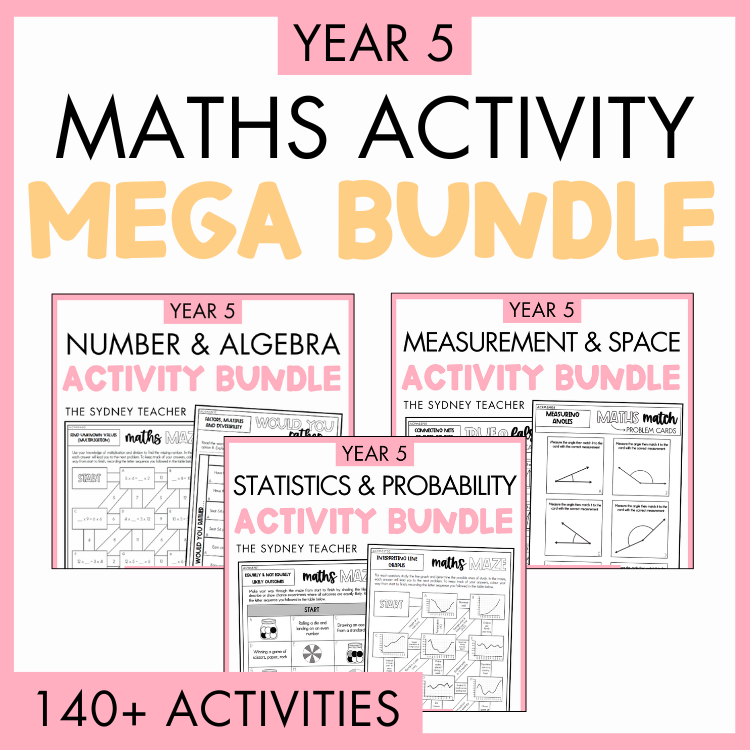
Purchase in this bundle
Why Choose The Year 5 Measurement & Space: Connect 3D Objects to their Nets (AC9M5SP01)?
- All six activities are aligned with the new Australian Curriculum (V9.0).
- Activities are interactive, hands-on and FUN!
- Purchasing this pack means there is NO planning required for outcome AC9M5SP01
- No prep, just print and go!
What's Included?
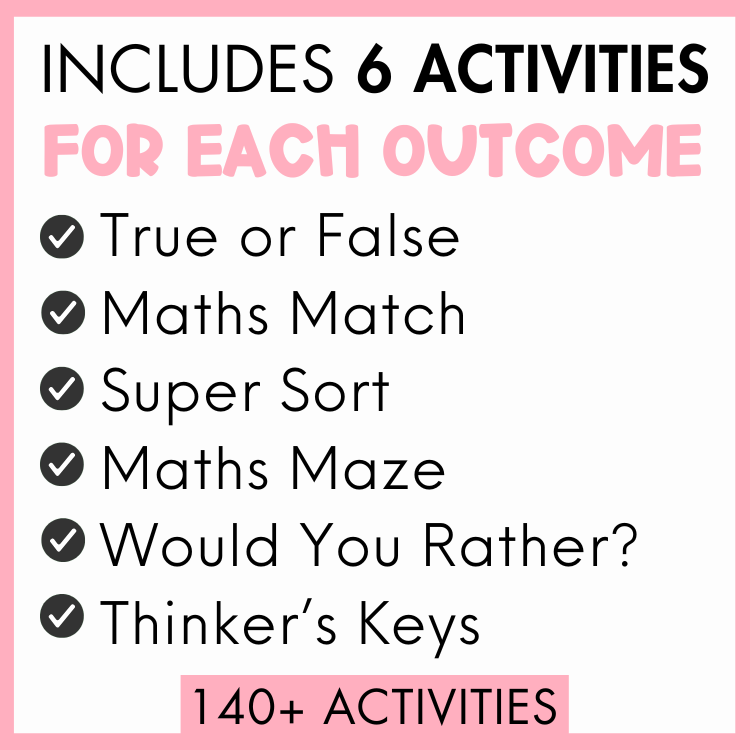
- True or false
- Maths match
- Super sort
- Maths maze
- Would you rather?
- Thinker's Key (problem solving)
- Answer sheets for teachers
Teachers Who Bought The Year 5 Measurement & Space: Connect 3D Objects to their Nets (AC9M5SP01), Also Loved...

Free Resources from The Sydney Teacher
Get free ideas and inspiration to use in your classroom today
Maths Warm Up: Mystery Number
Mystery Number
This maths warm-up turns a few number clues into a full-on maths detective mission. The best bit? You can make it as easy or as tricky as you like!
How It Works
Think of a number, give your students a series of clues, and let them figure out the mystery. The trick is to reveal the clues one at a time so students can narrow down the possibilities as they go.
Pop these clues on the board and see if your class can crack the code:
I am a 3-digit number between 300 and 400.
I am an even number.
My digits add up to 15.
My tens digit is double my ones digit.
After each clue, ask, "What could the number be now?" Encourage students to share their guesses and explain their reasoning as the possibilities get smaller.
The answer is 384, but don't give it away too soon!
Want to keep the fun going? Challenge students to create their own mystery numbers and write clues for a partner to solve. It's a great way to get them thinking about number properties from a different perspective.
Why It's So Good
• Builds number sense and logical reasoning.
• Encourages students to use clues to eliminate possibilities.
• Sparks mathematical discussions and encourages students to explain their thinking.
• Easy to differentiate by changing the number of digits or the complexity of the clues.
• Quick to set up and easy to repeat with new numbers.
Next time you're looking for a quick maths warm-up, give Mystery Number a go! Start with a few simple clues, let the guesses roll in, and see who can crack the code. You might even have your students asking to be the ones to create the next mystery!
Maths Warm Up: Maths Scavenger Hunt
Maths Scavenger Hunt
This maths activity is a fun, hands-on way to get students moving, thinking, and discovering just how much maths they can find right in their classroom or school.
How It Works
Give students one of the prompts below, depending on the maths concept you want to focus on. They can work independently, in pairs, or in small groups to find an object that matches the challenge and explain their thinking.
Number
Find a group of objects and describe the total in as many ways as possible (e.g. 8, double 4, or 2 × 4).
Find something with a number on it and share an interesting fact about that number. Is it odd, even, a multiple, a factor, or a square number?
Find a group of objects and represent the total as a fraction, decimal, or percentage of a larger group in the room.
Measurement
Find something approximately 30 cm long.
Find something that weighs about 500 grams.
Find something that could hold approximately 1 litre.
Space
Find an object shaped like a cylinder.
Find something with exactly four right angles.
Find two objects that have the same shape but different sizes.
Want to add a little friendly competition? Set a timer and see which team can complete the most challenges, or ask students to justify their answers before earning a point!
Why It's So Good
• Adds energy to your morning maths routine and encourages active participation.
• Helps students recognise mathematical concepts in everyday objects.
• Students need to explain why their chosen object fits the prompt.
• Adjust the challenges to suit different year levels and abilities.
• Choose your prompts, set your boundaries, and let the hunt begin!
These are just a few ideas to get you started, but the possibilities are endless! Pick a maths focus, send your students on a scavenger hunt, and see what they discover. You might be surprised by the mathematical thinking that comes from simply looking at familiar things in a new way.
Maths Warm Up: Maths Is All Around Us 3
Maths Is All Around Us
I've heard tales of people getting parking tickets because Dad didn't read the sign properly. And in my case? I came back to find my car being hoisted onto a tow truck. Yep, a very real and very expensive lesson in why reading the fine print matters!
It's also the perfect reminder that maths pops up in the most unexpected places, even when we're just trying to park the car.
How It Works
Display the photo to your class and ask students to answer these questions:
What time does the bus lane restriction start in the afternoon?
How many hours per week is this lane a dedicated bus lane?
If you parked under the 1P sign at 8:45 am on a Saturday, when would you need to move your car?
Encourage students to explain their reasoning, calculate time intervals, and discuss how misreading a sign could lead to real-life consequences. You could even ask them to write their own question based on the image!
Why It's So Good
• Shows students how maths helps us make everyday decisions.
• Practises students in reading timetables, calculating elapsed time, and interpreting time restrictions.
• Encourages students to read information carefully and consider different conditions.
• Connects mathematical reasoning to relatable, real-life experiences.
• Simply display the photo and let the questions get students thinking!
Use this picture prompt as your next Monday morning maths warm-up and see where the conversation takes you. It's a fun way to remind students that maths isn't just something we do in a workbook; it's something we use every single day!